
When the Next Virus Comes
A personal memory of Covid, a new viral warning, and the danger of forgetting what 2020 taught us

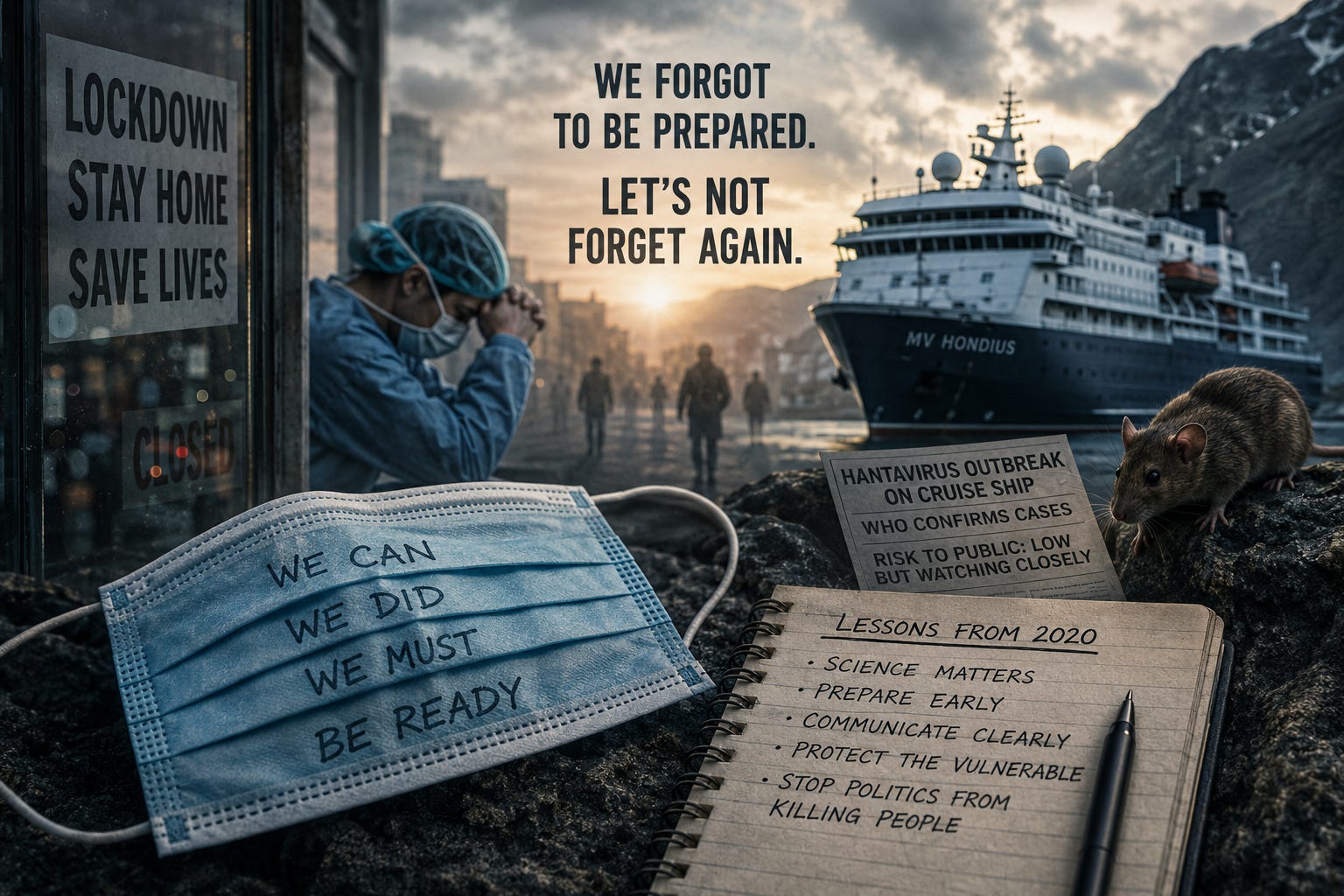
I remember 2020, and not with any fondness.
I was in the first wave of people who caught Covid. How I got it, from where I got it, I will never know. There was a period then when the virus seemed less like a disease than a fog: everywhere and nowhere, present before we understood it, already moving through rooms, trains, offices, airports, bodies.
I was never more sick in my life.
I had fevers that made me fantasise about plunging myself into a glacier. I had chills that no layering of blankets could halt. I had moments when I felt I could not breathe. At one point I remember thinking, with awful clarity: This is it.
It was not it. I was lucky.
Others I knew were not so fortunate.
But Covid left its mark. I caught it in March 2020 and did not feel anything close to normal until at least June. Even then, recovery came in stages, like an unreliable electricity supply. The lights would flicker on, then fail again. It took at least a year before I recovered most of my former energy.
It aged me. I do not mean this metaphorically. My beard grew whiter. My face looked more worn. I could see, in the mirror, the residue of what the virus had done.
And then there were the wider injuries: unemployment, lockdowns, isolation, restrictions, fear. I was fortunate that the weather was often good and that I had a back yard in which to sit. Otherwise, recovery would have been an even more miserable affair. Many people had no garden, no space, no quiet, no financial cushion, no way to turn the months into anything other than survival.
The days and weeks blended into a homogeneous, tedious mass. Time did not pass. It congealed.
Then the vaccines arrived.
I remember my first shot of Pfizer. I remember sleeping on the couch afterwards while February rain fell outside my window. It felt, in that strange exhausted way, like the beginning of a door unlocking. Slowly but surely, the world reopened. Not perfectly. Not painlessly. Inflation came. Political rage came. The old world did not return exactly as it had been.
But it was better than the frozen uncertainty of 2020.
At the time, I hoped we had learned something.
I hoped we had learned that public health is infrastructure. Not an abstraction. Not “red tape”. Not a bureaucratic luxury to be gutted between crises. It is as real as roads, bridges, power stations, and water systems. You only discover how much you needed it when it begins to fail.
I hoped we had learned that expertise matters.
I hoped we had learned that politics cannot bully a virus into submission.
I hoped we had learned that the sentence “it probably won’t happen here” is not a strategy.
And yet here we are again, watching another outbreak emerge, this time of hantavirus linked to the MV Hondius cruise ship.
To be clear: this is not Covid 2.0. It would be irresponsible to pretend otherwise. The current outbreak involves the Andes strain of hantavirus, associated with a cruise ship cluster first reported to the World Health Organization on 2 May 2026. As of 11 May, the WHO had confirmed seven cases, with nine total reported cases including suspected ones, and three deaths.
The CDC says the overall risk to the American public remains extremely low. Routine travel, according to the CDC, can continue as normal.
That matters. Panic helps no one.
But complacency helps no one either.
The particular strain involved, Andes virus, can cause hantavirus pulmonary syndrome, a severe and potentially deadly lung disease. Hantaviruses are usually associated with exposure to infected rodents and their urine, droppings, or saliva. The Andes strain is unusual because rare person-to-person transmission is possible.
That does not make it a global pandemic in waiting. It does make it a test.
A test of surveillance. A test of coordination. A test of honesty. A test of whether public health systems can move quickly without losing proportion. A test of whether politicians can resist the temptation to turn epidemiology into theatre.
And this is where my confidence falters.
Not because science cannot handle this. Covid showed that science can move with astonishing speed. Vaccines were developed, tested, manufactured, distributed, and administered at a pace that would once have seemed miraculous. Medical professionals adapted under conditions of exhaustion and danger. Researchers sequenced, modelled, tracked, treated, revised, and learned in real time.
The problem was never primarily the science.
The problem was politics.
The problem was magical thinking dressed up as freedom. The problem was the conversion of masks, vaccines, distancing, and public health advice into tribal symbols. The problem was a political culture in which “I don’t wanna” became an organising principle.
I fear history is now moving in tighter circles.
The United States has a Health and Human Services Secretary, Robert F. Kennedy Jr., whose long history of vaccine scepticism was already controversial before he took office. In recent months, he has continued to face intense questioning over vaccines and public health policy, while reporting has raised concerns about vaccine-related research and communications being curtailed within federal agencies.
This is precisely the wrong atmosphere in which to face emerging infectious disease threats.
A virus does not care whether a politician wants applause. A virus does not care whether a minister finds scientific advice inconvenient. A virus does not care whether a population has become bored of expertise.
Viruses exploit delay. They exploit denial. They exploit vanity. They exploit the gap between what is true and what people are willing to hear.
The hantavirus outbreak may well be contained. I sincerely hope it is. The WHO has assessed the wider risk as low, and health authorities appear to be treating the matter with seriousness: repatriations, monitoring, specialist treatment centres, and clinical alerts are all part of the response. Seventeen Americans from the affected ship have been repatriated, with one testing mildly positive and another showing mild symptoms; passengers are being assessed and monitored.
That is what should happen. Calm competence. No melodrama. No denial. No grandstanding.
But the deeper question is not whether this outbreak becomes the next pandemic. It probably will not.
The deeper question is whether we are ready for the next one that could.
Because there will be a next one. Perhaps not hantavirus. Perhaps not influenza. Perhaps not coronavirus. Perhaps something we have not yet learned to name. But the microbial world has not signed a peace treaty with us. Climate disruption, habitat destruction, global travel, industrial agriculture, political instability, and weakening public institutions all create opportunities for pathogens to move.
The twentieth century gave us the 1918 flu pandemic. The twenty-first has already given us Covid. The comforting “once in a century” rhythm may be a story we tell ourselves because the alternative is too frightening.
What worries me most is not the existence of another pathogen. It is the possibility that we have already squandered the moral memory of 2020.
We remember the inconvenience, but not the terror.
We remember the restrictions, but not the refrigerated trucks.
We remember the arguments, but not the nurses with bruised faces from masks.
We remember being told what to do, but not why we were told to do it.
That is a dangerous kind of forgetting.
In 2020, many of us learned that civilisation is thinner than it looks. The supermarket shelves empty quickly. The hospital systems strain quickly. The conspiracy theories spread quickly. The people who seemed sensible yesterday can be talking nonsense by Friday.
But we also learned something else. We learned that care is infrastructure too. That public duty is not weakness. That the vulnerable are not disposable. That “my choice” is not the only moral sentence in the language.
I do not want to live through 2020 again. I do not want anyone to live through it again. I do not want another year of sirens, dashboards, press conferences, denial, death counts, and the strange suspended grief of a world indoors.
So no, I am not panicking about hantavirus.
But I am watching.
I am watching the scientists. I am watching the doctors. I am watching the public health agencies. I am watching the politicians who, once again, may be tempted to treat reality as an enemy.
And I hope - sincerely, desperately - that the medical professionals are more prepared this time.
Because if our politics has learned nothing, they may be our last line of defence.